


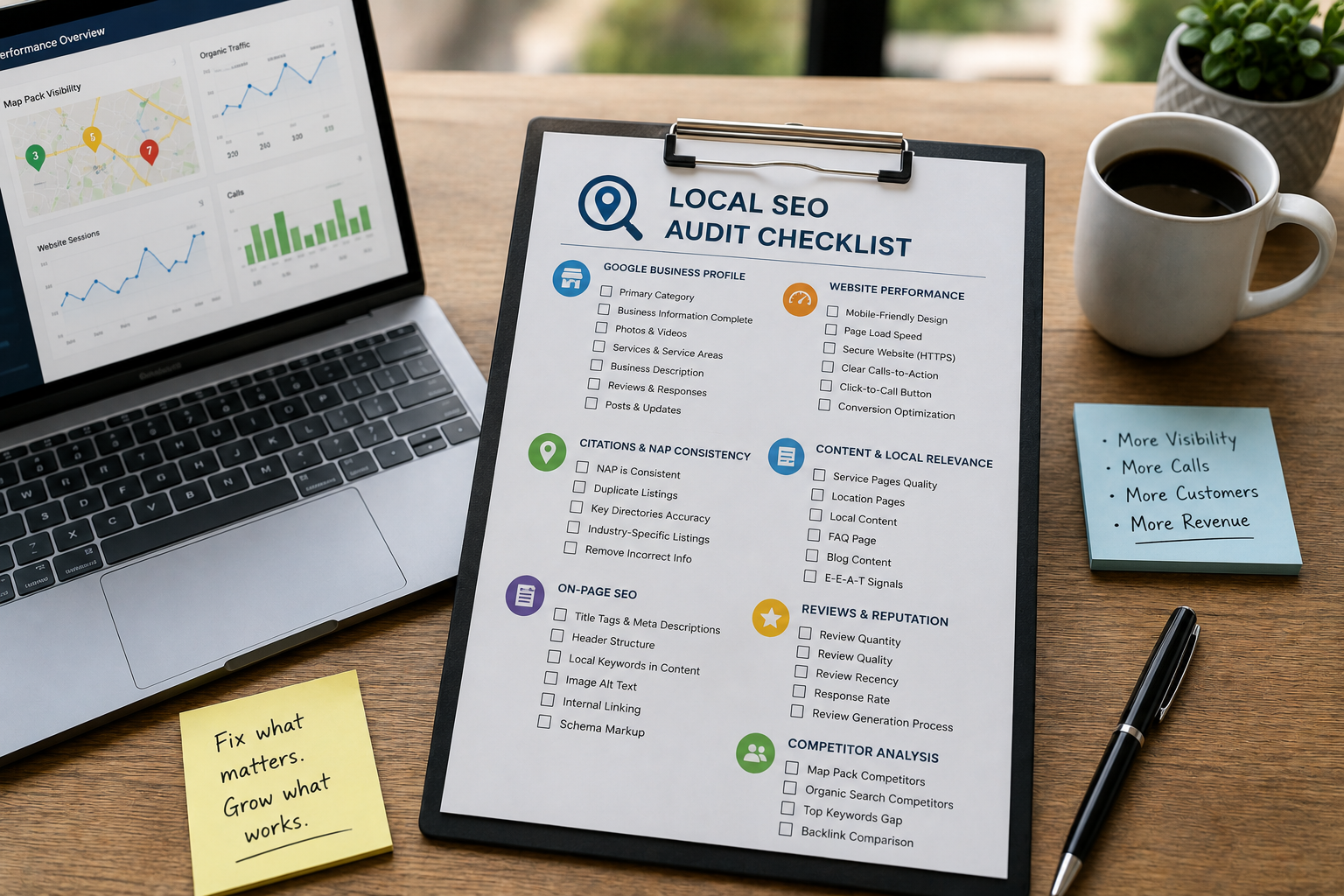
If your phones are slower than they should be, a local SEO audit checklist review usually reveals why. In most cases, the problem is not one big failure. It is a stack of smaller issues – an incomplete Google Business Profile, weak location signals, inconsistent citations, thin service pages, slow mobile performance, or reviews that are not being managed with any real strategy.
For local service businesses, SEO is not just about traffic. It is about showing up when someone nearby needs an attorney, roofer, HVAC contractor, plumber, dentist, or landscaper right now. That is why an audit has to be more than a box-checking exercise. It needs to connect rankings, maps visibility, website performance, and lead generation.
What a local SEO audit checklist review should actually tell you
A useful audit should answer three business questions. First, are you visible where local buyers are searching? Second, are you competitive against the businesses outranking you? Third, if you do win the click, does your website turn that visit into a call or form submission?
Many audits stop too early. They point out missing metadata or a few directory errors and call it done. That leaves owners with a list of technical notes but no idea which fixes will move revenue. A strong review prioritizes issues by impact. If your Google Business Profile categories are wrong, your map pack visibility may suffer more than a minor title tag problem. If your service pages are too broad, you may rank poorly even if your citations are clean.
Start with your Google Business Profile
For most local service companies, your Google Business Profile is one of the highest-value assets in the entire audit. It affects map rankings, credibility, click-through rate, and lead volume. Reviewing it means looking beyond whether the profile exists.
Check the primary category first. This choice influences what searches you are eligible to show up for. Secondary categories matter too, but they should support the core service, not dilute it. Then review the business description, service list, service areas, business hours, appointment options, and photos. An inactive profile often signals an inactive business, even when that is not true.
The review section matters just as much. Quantity helps, but relevance and recency matter too. A law firm with strong reviews mentioning practice areas and city names has a better local relevance signal than a profile with a pile of vague five-star ratings. At the same time, review management should stay natural. Stuffing keywords into responses or pushing for reviews in a way that feels forced can do more harm than good.
Map visibility depends on more than proximity
Business owners often assume local rankings are mostly about being closest to the searcher. Proximity does matter, but it is only one piece. Relevance and prominence matter too. That means your profile setup, reviews, citations, website signals, and local authority all influence what happens in Maps.
This is why two plumbers in the same city can see very different results. One has a complete profile, strong service pages, steady reviews, and clear location signals. The other has an outdated profile and a generic website. The difference is not luck. It is local SEO execution.
Review NAP consistency and citation quality
Name, address, and phone number consistency still matters, but not in the simplistic way many outdated checklists suggest. The goal is not to be listed on every directory on the internet. The goal is to have accurate, consistent business data in the places that carry trust and influence.
Your audit should look for duplicate listings, outdated phone numbers, old addresses, and inconsistent formatting that creates confusion. If your Google Business Profile shows one version of your business name while your website footer and major directories show another, that weakens trust signals.
That said, not all citation work has equal value. Cleaning major platforms and industry-relevant directories usually matters more than chasing dozens of low-quality listings. For a medical practice, legal office, or home service company, relevance often beats volume.
Evaluate your website like a lead-generation asset
A local SEO audit checklist review should not treat the website as separate from local rankings. Your website helps Google understand what you do, where you do it, and why your business deserves to rank. It also determines whether visibility turns into revenue.
Start with your core service pages. Do you have a clear page for each primary service, or are all services lumped onto one generic page? Businesses often underperform because they try to rank a single page for everything. A roofing company may need separate pages for roof repair, roof replacement, storm damage, and commercial roofing. A dental office may need distinct pages for implants, cosmetic dentistry, emergency care, and family dentistry.
Then look at your location targeting. If you serve multiple cities, your site should reflect that with meaningful local relevance. Thin copy with swapped city names is not enough. Each location page should explain the service offering, local context, trust signals, and next step for the visitor.
Mobile speed and conversion design affect SEO outcomes
A slow site does not just frustrate users. It reduces conversions and can weaken engagement signals. Since most local searches happen on mobile devices, your audit should check loading speed, tap targets, sticky headers, click-to-call functionality, and form usability.
This is where SEO and web design overlap. If your site ranks but makes it hard to contact you, the traffic is less valuable. For service businesses, every major page should make calling, booking, or requesting a quote simple.
Check your on-page local signals
On-page optimization still matters because it helps search engines connect your pages to specific services and service areas. Titles, headings, internal content, image alt text, and schema all contribute context.
The mistake is overdoing it. Repeating city names in every sentence does not make a page stronger. It usually makes it worse. Good local optimization reads naturally while clearly establishing service relevance. A well-built page talks like a business talking to real customers, not like a machine trying to game rankings.
A smart audit reviews whether pages include the right service keywords, local references, clear headings, and business details without crossing into spam. It should also check local business schema and whether the contact information on the page aligns with the rest of your online presence.
Look at reviews as both a ranking factor and a sales factor
Reviews influence visibility, but they also shape conversion rates. If you rank in the top three and your competitors have stronger reviews, better review language, and more recent feedback, they may win the click anyway.
Your audit should assess review volume, average rating, recency, response rate, and content quality across your key platforms. A contractor with 120 reviews from the past 12 months is sending a stronger freshness signal than one with 120 reviews accumulated over six years and no recent activity.
There is also a business process issue here. Reviews should not be treated as a side task someone remembers once a month. The strongest local performers build a repeatable review generation process into the customer experience.
Compare against real local competitors, not just obvious ones
One of the biggest mistakes in any local SEO audit checklist review is comparing your business to the wrong competitors. The company you think is your top competitor offline may not be the one taking the most search traffic online.
Your audit should identify who consistently appears in organic results and the map pack for your most valuable searches. Then compare category setup, review profile, page depth, local content, backlinks, and website performance. This creates a more honest benchmark.
You may find that a smaller company is outranking larger firms because they are simply more focused online. That is good news. It means local SEO gains are often achievable with the right strategy, not just the biggest budget.
Turn the audit into priorities, not just findings
The real value of an audit is what happens next. If you walk away with 40 issues and no order of operations, the audit did not do its job. Strong audits sort findings into high, medium, and low impact based on visibility, lead potential, and ease of implementation.
For many service businesses, the highest priorities are usually Google Business Profile optimization, service page improvement, review generation, citation cleanup, and mobile conversion fixes. Other items may matter, but not all at once. It depends on where the biggest leaks are.
At Capstone Marketing, that is the difference between reporting for reporting’s sake and building a growth plan. Owners do not need a technical data dump. They need to know what to fix first, what it will likely improve, and how that connects to calls, leads, and revenue.
A good local SEO audit should leave you with clarity. Not vague reassurance, not a stack of disconnected recommendations, but a practical picture of where visibility is being lost and where growth can be gained. If your current checklist does not help you make better business decisions, it is not really an audit. It is just paperwork.