


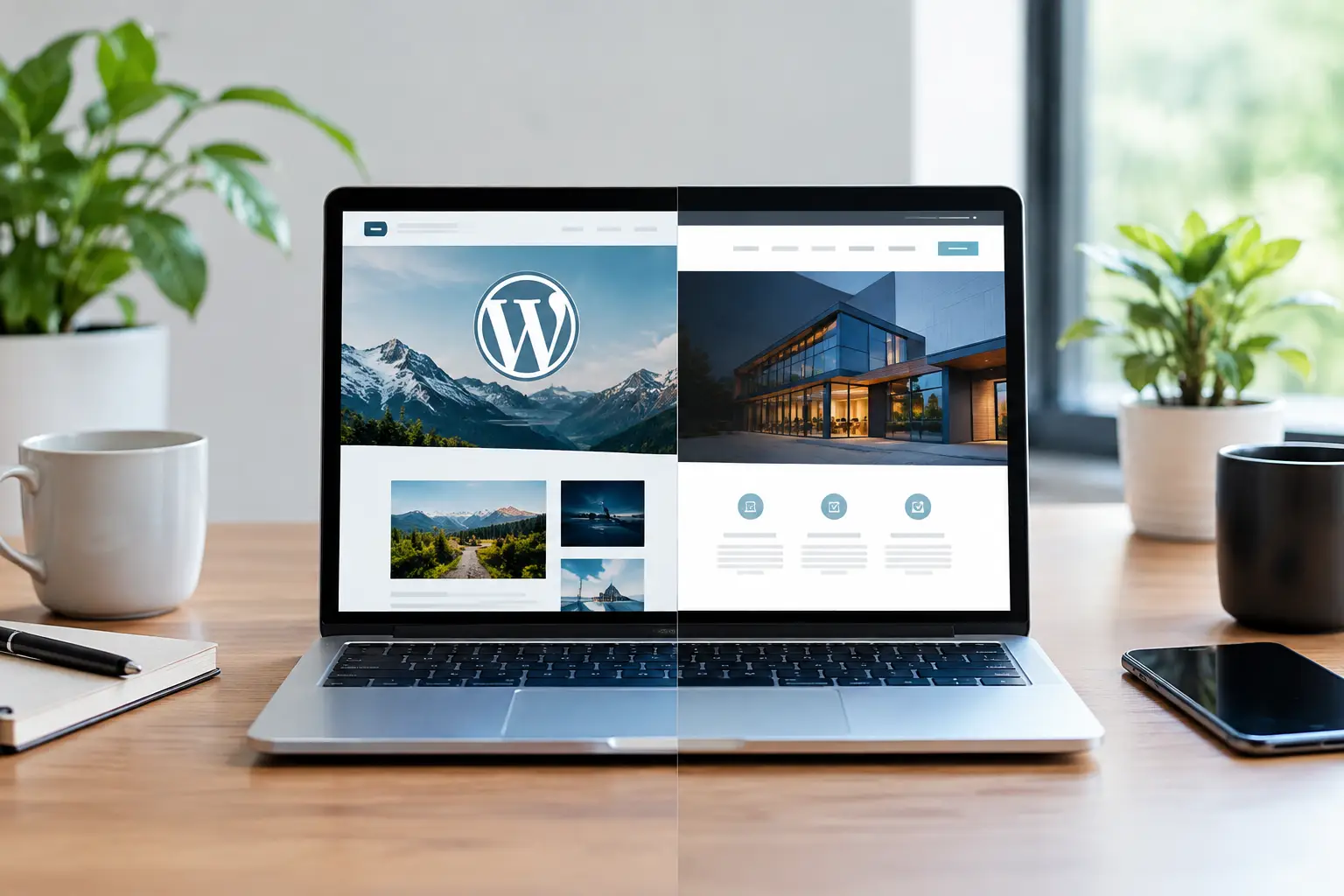
A website is not a digital brochure for most service businesses. It is where a homeowner decides whether to call your roofing company, a patient requests an appointment, or a potential client evaluates whether your law firm looks credible. That makes the WordPress vs custom business website decision less about technology preferences and more about lead generation, operating cost, and how easily your marketing can adapt.
For a local business in Shreveport, Bossier, Tyler, Longview, or East Texas, the best answer is rarely the platform with the most impressive sales pitch. It is the one that supports your next stage of growth without creating unnecessary cost, delays, or dependency.
What “Custom Website” Actually Means
The comparison is often framed too simply. WordPress is a content management system that can be configured with templates, plugins, and custom development. A custom business website is usually built from the ground up with custom code, a custom design system, or a proprietary content platform.
That distinction matters because a WordPress website can still be highly customized. Your pages, calls to action, forms, service area content, conversion paths, and visual identity can all be designed specifically for your business. It does not have to look like a generic template.
A fully custom site gives developers more control over every technical decision. That can be valuable for businesses with complex portals, custom quoting tools, location databases, membership features, or internal system integrations. But more control also means more development time, higher upfront investment, and a greater need for technical support.
WordPress vs Custom Business Website: The Core Trade-Off
WordPress usually wins when speed, marketing flexibility, and manageable cost are the priority. A custom-built platform may be the better option when the website itself performs a complex business function that standard tools cannot handle well.
For most local service businesses, the website’s primary jobs are straightforward: rank in local search, explain services clearly, build trust, collect calls and form submissions, and make it easy for staff to update information. WordPress handles those jobs well when the site is built correctly.
The problem is not WordPress. The problem is poorly planned WordPress sites loaded with unnecessary plugins, weak page structure, bargain-bin themes, and no ongoing maintenance plan. The same principle applies to custom websites. Custom code does not automatically create faster load times, stronger rankings, or more leads. Strategy and execution determine performance.
Speed to Market and Upfront Cost
A new HVAC company, dental practice, plumbing business, or law firm often needs a dependable website quickly. The longer a site takes to launch, the longer the business may rely on referrals alone, an outdated website, or expensive paid advertising that sends visitors to a weak conversion page.
WordPress generally allows for a faster launch because the publishing framework already exists. That gives more of the project budget to design, messaging, service pages, conversion tracking, local SEO structure, and mobile usability. Those are the elements visitors actually experience.
Custom development starts closer to zero. Every component may need to be designed, coded, tested, and documented. That can be appropriate for an organization with a specific technical requirement, but it is often more than a local service company needs. If your goal is to generate qualified calls for AC repair, roof replacement, estate planning, or commercial landscaping, a longer build timeline does not necessarily produce a stronger return.
The lower initial cost of WordPress should not be confused with “cheap.” A conversion-focused website still requires thoughtful planning, professional copy, custom design, technical SEO, quality photography or visual assets, and careful quality assurance. The question is whether you are paying for useful marketing infrastructure or unnecessary engineering.
SEO and Local Visibility
Search engine performance depends on much more than the platform. Google evaluates whether your site is useful, trustworthy, accessible, and relevant to what people are searching for. Clear service pages, accurate business information, mobile performance, strong content, and a well-managed Google Business Profile carry more weight than the label on your content management system.
WordPress gives marketing teams a practical advantage because it makes content updates easier. When you add a new service, expand into a nearby market, publish a case study, or update seasonal offers, the change can be made without rebuilding the site. That agility matters in competitive local markets.
A custom website can also perform exceptionally well in search. The risk is that simple SEO changes require a developer. If updating a title tag, publishing a location page, adding an FAQ, or improving a call-to-action button becomes a development ticket, your marketing loses momentum.
For businesses that rely on local leads, look for a website setup that supports fast page loads, clean navigation, service-specific content, structured data where appropriate, conversion tracking, and simple publishing workflows. Those foundations matter more than choosing the most technical solution.
Ownership, Security, and Ongoing Maintenance
Business owners should ask a direct question before approving any website project: if we need to make a change six months from now, who can do it and what will it cost?
With WordPress, you can typically maintain control of your domain, hosting, content, analytics, and website files. It is widely used, so you are not locked into one developer or agency if your needs change. However, WordPress requires maintenance. Core software, plugins, themes, backups, security monitoring, and performance checks need ongoing attention.
Custom platforms can create more dependency. If the system is proprietary, only the original developer may understand how it works. That can make future changes expensive or slow. A well-documented custom build from a reliable development partner can avoid this issue, but business owners should confirm ownership rights and support terms in writing.
Security is not automatically better on either option. An abandoned WordPress site with outdated plugins is a risk. A custom site with poorly maintained code is also a risk. The right choice is one your team or marketing partner can actively maintain.
When a Custom Website Is Worth the Investment
A custom business website becomes more compelling when the website needs to do more than market your services. For example, you may need a client portal tied to internal records, a multi-location inventory system, a complicated online quoting workflow, role-based access, or software integrations that standard tools cannot handle reliably.
It can also make sense for a larger company with established marketing operations, an internal technical team, and a long-term product roadmap. In that situation, the cost of custom development may be justified by the operational value it creates.
Even then, do not treat custom development as a branding upgrade. Start with requirements. Identify what customers need to do, what data must move between systems, what staff must manage, and what a failed workflow would cost. If those needs can be solved with proven tools and a well-built WordPress site, custom code may not be the best use of capital.
What Most Local Businesses Need Instead
Most service-based businesses do not need a complicated website. They need a clear, fast, mobile-first sales tool built around the way customers search and make decisions.
That means prominent calls to action, service pages that answer real questions, location relevance without thin duplicate content, reviews and trust signals, simple forms, click-to-call functionality, and reporting that shows where leads come from. It also means a plan for ongoing improvement. A website should be measured by calls, booked appointments, qualified submissions, and cost per lead, not by how many design features it contains.
A professionally built WordPress site is often the practical choice because it gives businesses the flexibility to add landing pages for paid advertising, publish new content for SEO, and adjust messaging as the market changes. Capstone Marketing typically approaches website decisions through that lens: what will help the business attract, convert, and measure more qualified local leads?
Choose the Platform That Supports the Next Decision
Before choosing a platform, map out the next 12 to 24 months. Are you adding services? Opening another location? Running Google Ads? Building out local SEO pages? Do you need staff members to make frequent content changes? Or are you building a specialized system that requires custom functionality?
If your priority is lead generation and marketing flexibility, WordPress is usually the efficient, proven path. If your requirements demand unique functionality that cannot be responsibly delivered with established tools, a custom website may earn its higher cost.
The best website is not the one with the most code behind it. It is the one that makes it easier for the right customer to find you, trust you, and take the next step.